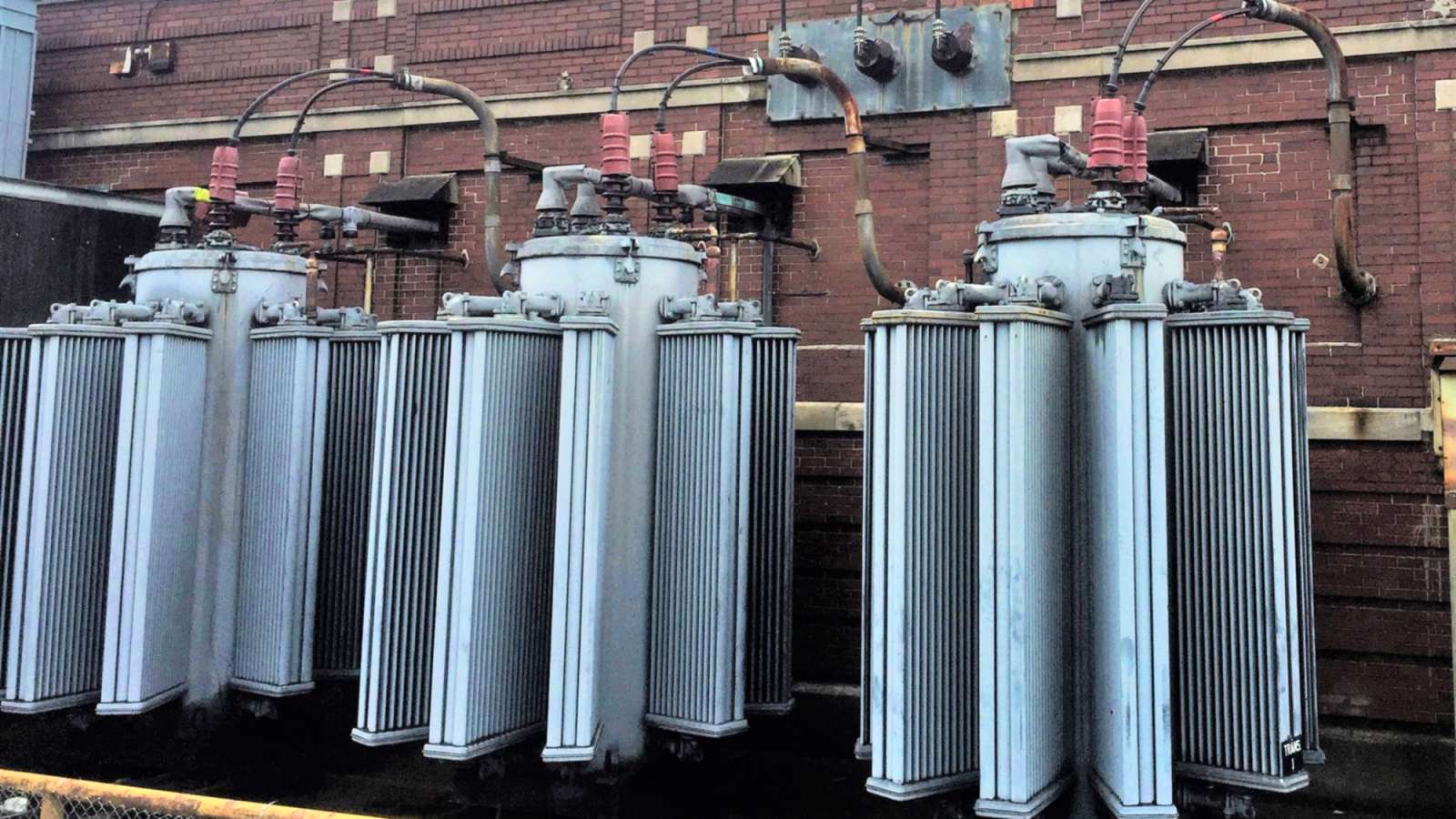
Nestled against an old brick wall of a substation control house, behind a fence on the corner of Magazine and 13th Streets in downtown Louisville, they stand. Other than a quiet, constant hum, they go unnoticed, although they weigh 11 tons each.
"These are the grizzled survivors," said Adam Parks, Principal Engineer. He knocks on wood for luck. "They've never failed. That's rare. Even a new transformer today can fail when first energized."
A faded grey color, they are cylinders with several large radiators, bigger than doors, which fan out around their sides. They stand upon small sections of old railroad tracks, and they have been doing their work now since 1926. They are the oldest substation transformers (single phase 14-4kV) on the entire LG&E and KU system.
"The city has grown up around them," said Adam.
Jude Beyerle, Manager, Engineering, points out these three transformers have been in service since before Charles Lindbergh's first flight across the Atlantic, before the Great Depression and long before World War II.
"Their ability to deliver power reliably to our customers for a full century is a testament to quality construction, and sound planning, maintenance and operating practices," said Jude.
With about 600 substations on the LG&E and KU system, there are more than a thousand transformers that perform this type of work. Very few come close to being as old as these three. The typical lifespan for power transformers is often in the range of 50 to 60 years.
These three survived the Great Flood of 1937, the worst Ohio River flood in history. The river reached nearly 30 feet above flood stage and put about 70% of the city under water, forcing more than 175,000 people to flee their homes. It wouldn't require a massive flood, however, to cause the transformers to fail. All it would take would be a nimble squirrel getting past the guarding and into the wrong spot.
"My greatest fear is probably an animal crawling up on top of one," said Adam. "Or internally, I would say just a failure of the paper insulation inside."
Over time, high voltage stresses in a transformer can lead to a puncture of the oiled insulation, which, in 1926, was made of paper (similar to today, although modern paper can withstand higher temperatures). "As it ages, that paper can start to flake off and degrade, and that allows the electric field to puncture it."
Modern substation transformers can cost about $2 million each. New ones operate a little more efficiently, consuming less power than these three, and have electronics and cooling fans inside them.
"I'm not sure how much these three cost in 1926, but I'd say the customer got their return on their investment," said Adam. "For these to have lasted so long, our personnel have done a good job maintaining them. Generations of people have gone their whole careers working on these."
Nothing lasts forever. In 2019, three similar transformers at the same location, also built in 1926 by Westinghouse Electric & Manufacturing Company, were retired and replaced with modern versions. That fate also awaits these three, probably sometime around 2030, as part of a multi-year conversion of the LG&E 4kV distribution system to 12kV.
For now, however, these three veterans will keep humming along, stepping down power so that thousands of customers can use their mobile phones, laptops and other devices unimagined in 1926.
"Really the world has changed," said Jude. "And they haven't."